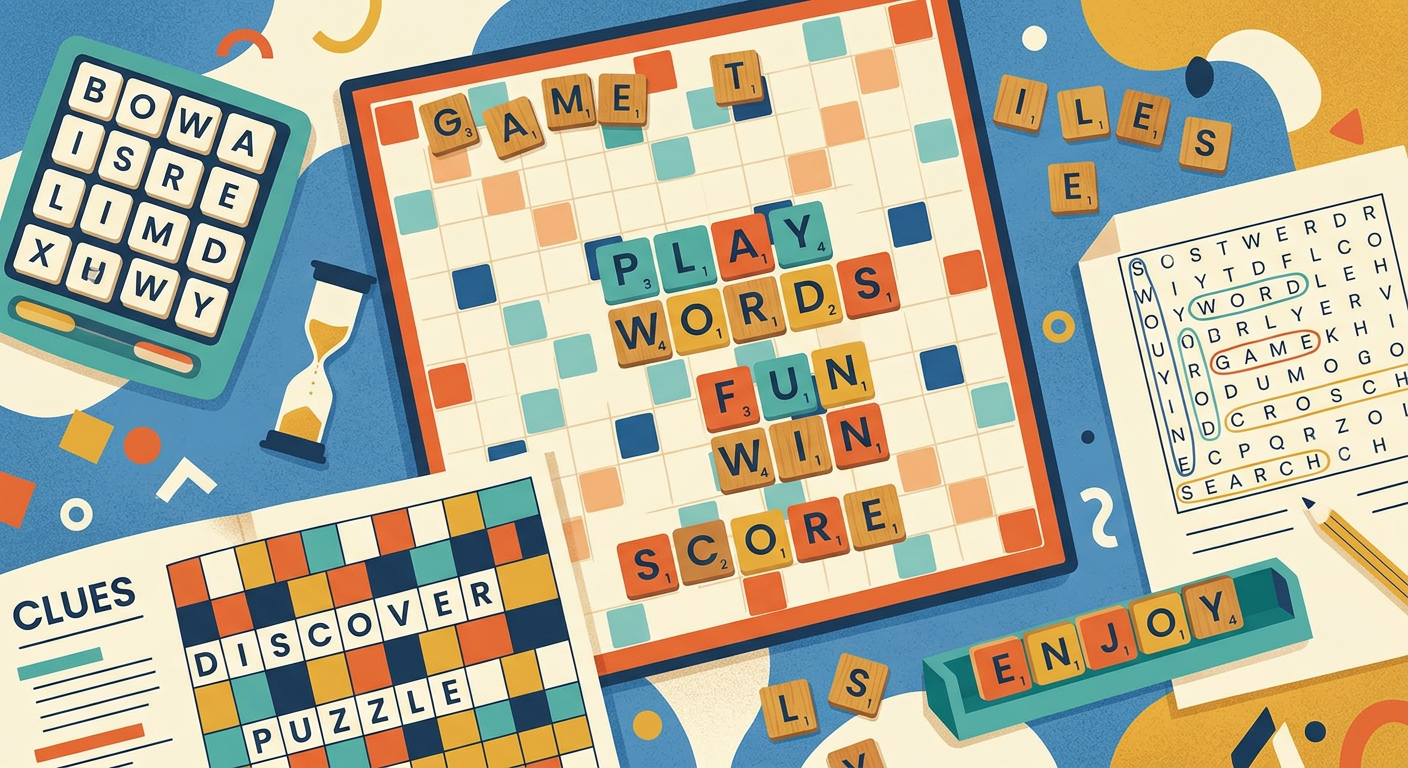
Word games come in many forms, from classic tile-based board games to daily online puzzles. Each game has its own rules, scoring systems, and strategies, but they all share one fundamental challenge: you need to find words from letters. A word unscrambler helps with all of them. In this guide, we break down game-specific strategies for the most popular word games and explain how to get the most out of the tool for each one.
Disclaimer: This word unscrambler is an independent utility tool. It is not affiliated with, endorsed by, or sponsored by the owners of Scrabble, Words With Friends, Wordle, or any other game or brand mentioned in this article. All trademarks are the property of their respective owners. This tool is provided for educational and entertainment purposes.
Scrabble: Maximizing Score From Your Rack
Scrabble is the classic tile-based word game where players build words on a board using letter tiles with different point values. The goal is to score the most points, not just to find the longest word. Here is how to use a word unscrambler effectively for Scrabble:
Sort by score, not just length
The biggest mistake new players make is always going for the longest word. A 4-letter word using high-value tiles like Q, X, Z, or J placed on a triple-letter or triple-word square can outscore a 7-letter bingo that uses only common letters. Use the word unscrambler and sort results by Scrabble-style score to compare options at a glance.
Save your S and blank tiles
An S is incredibly versatile because it pluralizes almost any noun. A blank tile can be any letter. Do not waste these on low-scoring plays. Save them for high-scoring opportunities — an S added to a word that hits a triple-word square doubles the value of that play.
Hunt for bingos
Using all seven tiles in one play earns a 50-point bonus. Use our 7-letter word unscrambler to hunt for bingos. Set the length filter to 7 and check if any full-length words exist in your rack. For more on this, read our 7-letter word guide.
Consider board position
The unscrambler shows you possible words, but you still need to evaluate board position. A word that hooks onto an existing letter (using the "starts with" or "contains" filter with that letter) can reach premium squares. Always think about where the word goes on the board, not just what it is.
Wordle and 5-Letter Guessing Games: Strategic Deduction
Daily 5-letter guessing games reward deduction and vocabulary breadth. You have limited guesses to identify a hidden 5-letter word, with feedback after each guess. Here is how a word unscrambler helps:
Find words matching known constraints
After a few guesses, you know which letters are in the word, which are not, and sometimes which positions are confirmed. Use the 5-letter word unscrambler with filters:
- Set length to 5.
- Enter confirmed "starts with" and "ends with" letters.
- Enter "contains" for letters you know are in the word but whose positions are uncertain.
- Use wildcards (? or _) for unknown positions.
For example, if you know the word starts with S, contains E, and is 5 letters, enter your available letters with those filters to see all matching candidates. This turns guesswork into systematic deduction.
Choose starting words wisely
Strong starting words test multiple vowels and common consonants. Words like ADIEU, AUDIO, CRANE, SLATE, and RAISE are popular because they gather maximum information. Use the unscrambler to explore alternative starting words that match your personal strategy.
Avoid reusing eliminated letters
Once a letter is confirmed absent, do not use it again. The unscrambler's filters help you build words from only the remaining candidates, preventing wasted guesses.
Words With Friends: Adapting to a Different Board
Words With Friends plays similarly to Scrabble but with a different board layout, slightly different tile values, and a different dictionary. The core strategies are the same, but here are the key differences to keep in mind:
- Different bonus square layout: The placement of double/triple letter and word squares differs from Scrabble. Adjust your board strategy accordingly.
- Slightly different tile values: Some letters have different point values. The unscrambler's score sorting gives a general idea, but verify exact values for your game.
- Different dictionary: Some words valid in Scrabble are not valid in Words With Friends and vice versa. If a word is rejected by the game, move on to the next option from your unscrambler results.
Anagram and Jumble Puzzles: Exact Rearrangements
Anagram puzzles and newspaper jumbles require you to rearrange all letters of a word or phrase to form another word or phrase. For these, use the anagram solver mode, which shows only exact anagrams. Read our comparison of unscramblers vs anagram solvers to understand when each is appropriate.
For jumbles, you typically need to unscramble several short words and then use selected letters to form a punchline. Unscramble each word individually, then use the unscrambler again on the selected letters to find the final answer.
Crossword Puzzles: Filling In the Gaps
Crosswords give you partial words and clues. A word unscrambler with wildcards and filters is perfect for this:
- Enter known letters and use ? for unknown positions.
- Set the length filter to the number of squares in the answer.
- Use "starts with" and "ends with" for the first and last letters if known.
- Use "contains" for any letter you know is in the answer.
For example, if the clue is "Fast feline (7 letters)" and you have C?E?A?D, enter C?E?A?D with a length of 7. The tool returns matching words like CHEETAH... wait, CHEETAH is C,H,E,E,T,A,H — does not match C?E?A?D. The correct answer here is likely CHEAPHD (not valid). In practice, crosswords use real words, so the tool returns valid matches. The point is that wildcards plus filters make crossword solving much faster.
Boggle and Word Search: Finding Words in a Grid
In Boggle, you find words in a grid of letters where adjacent letters must connect. While a word unscrambler does not replicate the adjacency rules, it helps in two ways:
- Vocabulary building: After a game, enter all your grid letters to see words you missed. This builds your vocabulary for future games.
- Pattern recognition: Seeing the full word list from a set of letters trains your brain to spot word patterns in grids more quickly.
Text-Based Word Games and Apps
Many mobile and online word games involve unscrambling letters to form specific words. These range from simple anagram games to complex levels with specific target words. The word unscrambler helps with all of them by showing every possible word from your available letters. Use filters to match the game's constraints (specific length, starting letter, etc.).
General Tips for All Word Games
- Learn your 2-letter words. In tile-based games, 2-letter words are essential for parallel plays. There are around 100 valid 2-letter words — learn them all.
- Memorize high-value short words. Words with Q, X, Z, and J that are 3-4 letters long are worth their weight in gold: QAT, XIS, ZAG, ZED, JAI, QIS.
- Practice rack management. In tile games, try to keep a balanced rack (a mix of vowels and consonants) rather than holding onto difficult letters.
- Review after each game. Enter your letters into the unscrambler after a game to see words you missed. This is the fastest way to improve.
- Use the right tool for the job. For exact anagrams, use anagram mode. For 5-letter puzzles, use the 5-letter tool. For everything else, the main unscrambler has you covered.
Ethical Use of Word Unscramblers
A word unscrambler is a powerful tool, and like any tool, it should be used responsibly. In casual play, using it to learn new words and improve your game is perfectly fine. In competitive play, check the rules first. Many tournaments and online platforms prohibit external aids during live play. When in doubt, ask your opponent or check the platform's terms of service. The best use of a word unscrambler is as a training tool between games, not as a crutch during them.
Frequently Asked Questions
Is it okay to use a word unscrambler while playing word games?
That depends on the context. For casual play, practice, and learning, a word unscrambler is a great tool for building vocabulary and recognizing patterns. For competitive, ranked, or tournament play, check the rules of your game or platform — many prohibit external tools during live play. Always play fair and respect the rules.
Which word games work best with a word unscrambler?
Word unscramblers are useful for any game that involves forming words from letters, including tile-based games, 5-letter guessing games, anagram puzzles, crossword puzzles, and jumble puzzles. The specific strategies vary by game, but the core tool works across all of them.
Does this tool work for Words With Friends?
Yes. Our word unscrambler uses a comprehensive English dictionary that covers most words accepted in Words With Friends. Note that some games have slightly different dictionaries, so a word that is valid in one game might not be valid in another. Always verify with your game dictionary if you are unsure.
Is this word unscrambler affiliated with any game company?
No. This is an independent word utility tool. It is not affiliated with, endorsed by, or connected to the owners of Scrabble, Words With Friends, Wordle, or any other game or brand. All trademarks are the property of their respective owners.