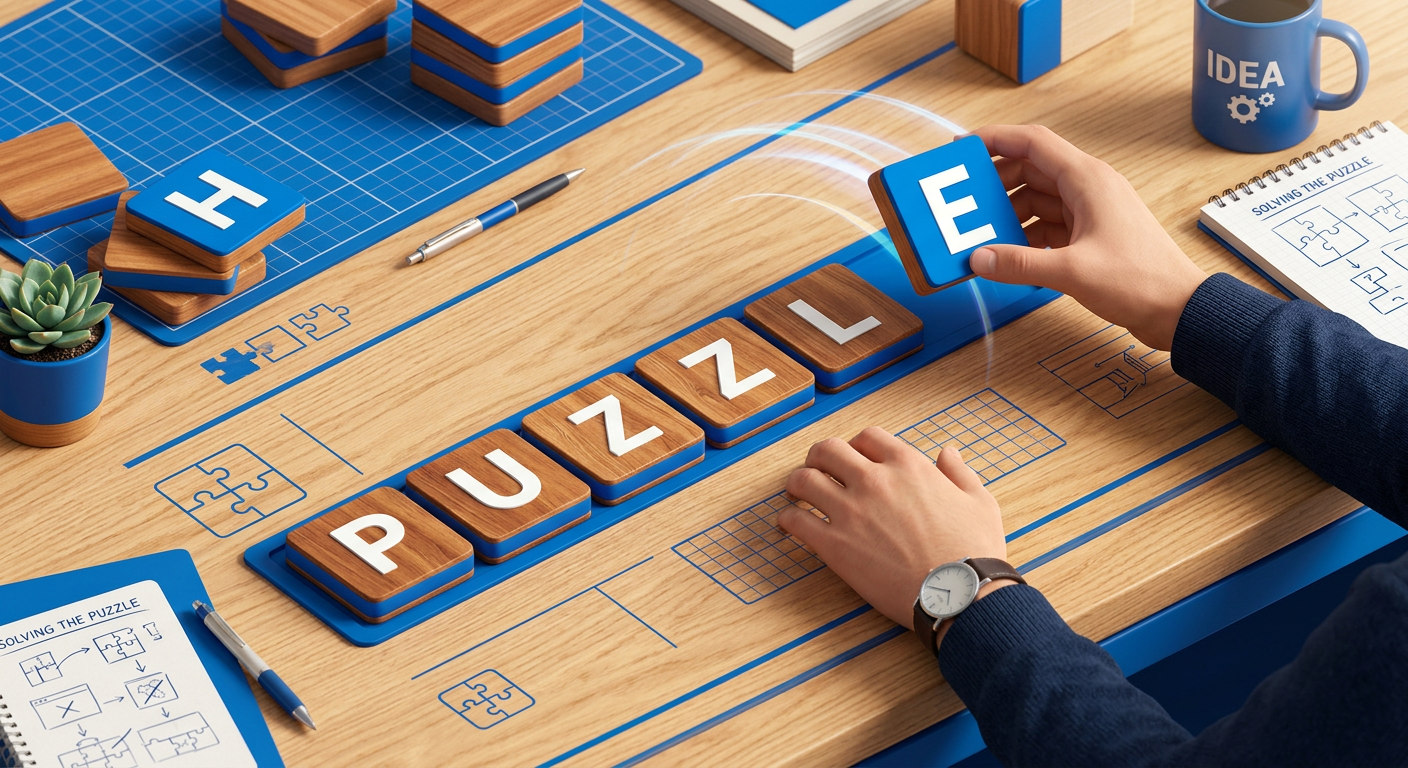
Seven-letter words are the holy grail of tile-based word games. In Scrabble, using all seven tiles in one play earns a 50-point bonus known as a bingo. Finding these words from a random rack of letters is challenging, but with the right strategies and tools, it becomes much more manageable. This guide covers everything you need to know about unscrambling 7-letter words, from basic techniques to advanced strategies, and how to use our 7-letter word unscrambler to find them fast.
Why 7-Letter Words Matter
In most tile-based word games, you hold seven tiles at a time. This is not a coincidence — seven letters create a meaningful challenge. There are enough letters to form substantial words, but the combinations are complex enough that finding the best one requires skill. Here is why mastering 7-letter words is so valuable:
- Bingo bonus: In Scrabble and many similar games, using all seven tiles earns a 50-point bonus. Over the course of a game, even one or two bingos can be the difference between winning and losing.
- Board control: A 7-letter word covers more of the board, potentially reaching premium squares and setting up or blocking future plays.
- Rack management: Finding 7-letter words clears your rack completely, giving you seven fresh tiles on your next turn. This is far better than being stuck with difficult letters.
- Vocabulary expansion: Learning 7-letter words exposes you to less common but valid English words, expanding your overall vocabulary.
The Bingo-Hunting Strategy
Finding a 7-letter word (a bingo) from your rack requires a systematic approach. Here is the method used by experienced players:
Step 1: Separate your tiles
Lay out your seven tiles and separate vowels from consonants. A typical bingo-friendly rack has 2-4 vowels and 3-5 consonants. If you have only one vowel, bingos are rare but not impossible (think of words like RHYTHMS or STRENGTH, though the latter has two vowels if you count E).
Step 2: Identify suffixes
Suffixes are the most powerful tool for finding bingos. If your rack contains letters that form a common suffix, you can focus on unscrambling the remaining letters into a base word. The most productive suffixes for bingos are:
| Suffix | Example Bingo |
|---|---|
| -ING | SKATING (SKATE + ING) |
| -ED | STOPPED (STOPP + ED) |
| -ER | TEACHER (TEACH + ER) |
| -EST | GREATEST (GREAT + EST, but needs 8) |
| -LY | SWEETLY (SWEET + LY) |
| -TION | ACTION (ACT + ION, but only 6) |
| -NESS | DARKNESS (DARK + NESS, but needs 7 total: D,A,R,K,N,E,S) |
| -MENT | AGREEMENT (needs 9), but MOVEMENT (MOVE + MENT, needs 7: M,O,V,E,M,E,N,T = 8) |
Note that some suffixes like -TION and -MENT often create words longer than 7 letters. The most common bingo suffixes are -ING, -ED, -ER, -EST, and -LY because they are short and combine easily with 4-5 letter base words.
Step 3: Identify prefixes
Prefixes work the same way as suffixes but at the beginning of the word. If your rack contains RE, UN, OUT, or OVER, try placing them at the start and unscrambling the rest:
- RE- + OPENED (but that is 7 total: R,E,O,P,E,N,E,D = 8). Better example: RE+TAKEN = RETAKEN (7 letters: R,E,T,A,K,E,N).
- UN- + TIRED = UNTIRED (7 letters: U,N,T,I,R,E,D).
- OUT- + LIVED = OUTLIVED (8 letters). OUT+RUNS = OUTRUNS (7 letters: O,U,T,R,U,N,S).
Step 4: Combine prefixes and suffixes
Sometimes a bingo uses both a prefix and a suffix around a short root. For example, UN+RE+AL = UNREAL (6 letters), but UN+REAL+LY = UNREALLY (8 letters, but not standard). Better examples: RE+TAKEN (7 letters), UN+STABLE = UNSTABLE (8 letters). The key is to experiment with combinations.
Worked Examples
Example 1: Letters S, T, R, A, I, N, E
Seven letters. Vowels: A, I, E (three vowels — bingo-friendly). Consonants: S, T, R, N. Looking for suffixes: -INE is possible (but that is a word fragment, not a suffix), -ER is not available (no second E or R... we have one R). Let us look for anagrams: RETAINS, RETINAS, RETSINA, STAINER, NASTIER, ANSERIT (not valid). The valid 7-letter anagrams include RETAINS, RETINAS, STAINER, and NASTIER. Six words from the same letters — a great bingo rack.
Example 2: Letters P, L, A, Y, I, N, G
Seven letters. Vowels: A, I (two vowels). Consonants: P, L, Y, N, G. Notice the -ING ending immediately. Remove I, N, G and we have P, L, A, Y left. PLAY + ING = PLAYING (7 letters). This is a textbook example of how spotting a suffix leads directly to a bingo.
Example 3: Letters C, A, R, E, T, A, K
Seven letters. Vowels: A, E, A (three vowels, with a repeated A). Consonants: C, R, T, K. Looking for suffixes: -ER needs an R (we have one) and the remaining letters C, A, E, T, A, K need to form a 5-letter word: CAKET (not valid), TEACK (not valid). Let us try anagrams directly: TEACRAK (no). Actually, rearranging: KARTACE (no). Let us try: the anagram is actually not obvious. Using our anagram solver, we find words like RETACK (6 letters, drops one A) and CATMARK (6 letters). The full 7-letter anagram might be harder to find — this is where a tool becomes essential.
Strategies for Difficult Racks
Not every rack yields an easy bingo. Here is what to do when your letters are uncooperative:
Drop a letter and find 6-letter words
If no 7-letter word exists, remove one tile at a time and look for 6-letter words. This is often more productive than staring at all seven letters. A 6-letter word still scores well and clears most of your rack.
Look for compound words
Some 7-letter words are compounds of two shorter words: PLAYOFF, SUNFISH, HANDOUT, FOOTMAN. If your rack contains two short words, try combining them.
Use the S wisely
An S is the most versatile tile for bingos because it can pluralize almost any noun. If you have an S, try forming a 6-letter word and adding the S to make it 7. But be careful — in some game situations, saving the S for a future play is strategically better.
Consider less common words
Competitive players memorize lists of 7-letter words that are valid but uncommon. Words like AAHED, AALIIS, AARGHS, and ABASIA are rarely used in conversation but are perfectly valid in tournament play. You do not need to memorize all of them, but being aware that unusual words exist helps you spot them when your rack seems impossible.
Using the 7-Letter Word Unscrambler
Our 7-letter word unscrambler makes bingo-hunting fast and thorough. Enter your seven letters, set the length filter to 7, and see every valid 7-letter word instantly. If no bingo exists, change the filter to 6 to find the next best option. You can also sort by score to find the highest-value word, and use "starts with" or "contains" filters when you have a hook on the board (a letter already played that your word must connect to).
For even more power, try using wildcards. If you have a blank tile, enter ? as one of your letters. The tool treats it as any letter and shows all possible bingos. Learn more in our guide to wildcards with a word unscrambler.
Expanding to Other Word Lengths
The same techniques apply to other word lengths. If you are working with 8 letters, use our 8-letter word unscrambler. For general unscrambling across all lengths, start at the main word unscrambler. For a broader guide to the unscrambling process, read our step-by-step guide, and for tips on handling very long letter sets, see our guide to unscrambling long words.
Frequently Asked Questions
How many 7 letter words can I make from a typical rack?
A typical 7-letter rack can yield dozens of valid words across all lengths. For the full 7-letter anagram (bingo), most racks contain at least one valid 7-letter word, though finding it manually can be difficult. Our 7-letter word unscrambler shows all possibilities instantly.
What is a bingo in word games?
A bingo is when you use all 7 of your tiles in a single play. In Scrabble, this earns a 50-point bonus on top of the word score. Finding bingos is one of the most important skills for competitive play.
How do I find 7 letter words more easily?
Look for common suffixes like -ING, -ED, -ER, -TION, and -MENT. If you have one of these in your rack, try placing it at the end and unscrambling the remaining letters. Also look for prefixes like RE, UN, and OUT. Using a word unscrambler with a length filter set to 7 makes this much faster.
Are 7 letter words always the best play?
Not always. A 7-letter bingo usually scores well due to the bonus, but sometimes a shorter word placed on premium squares scores more. Always compare your options, especially when bonus squares are available on the board.