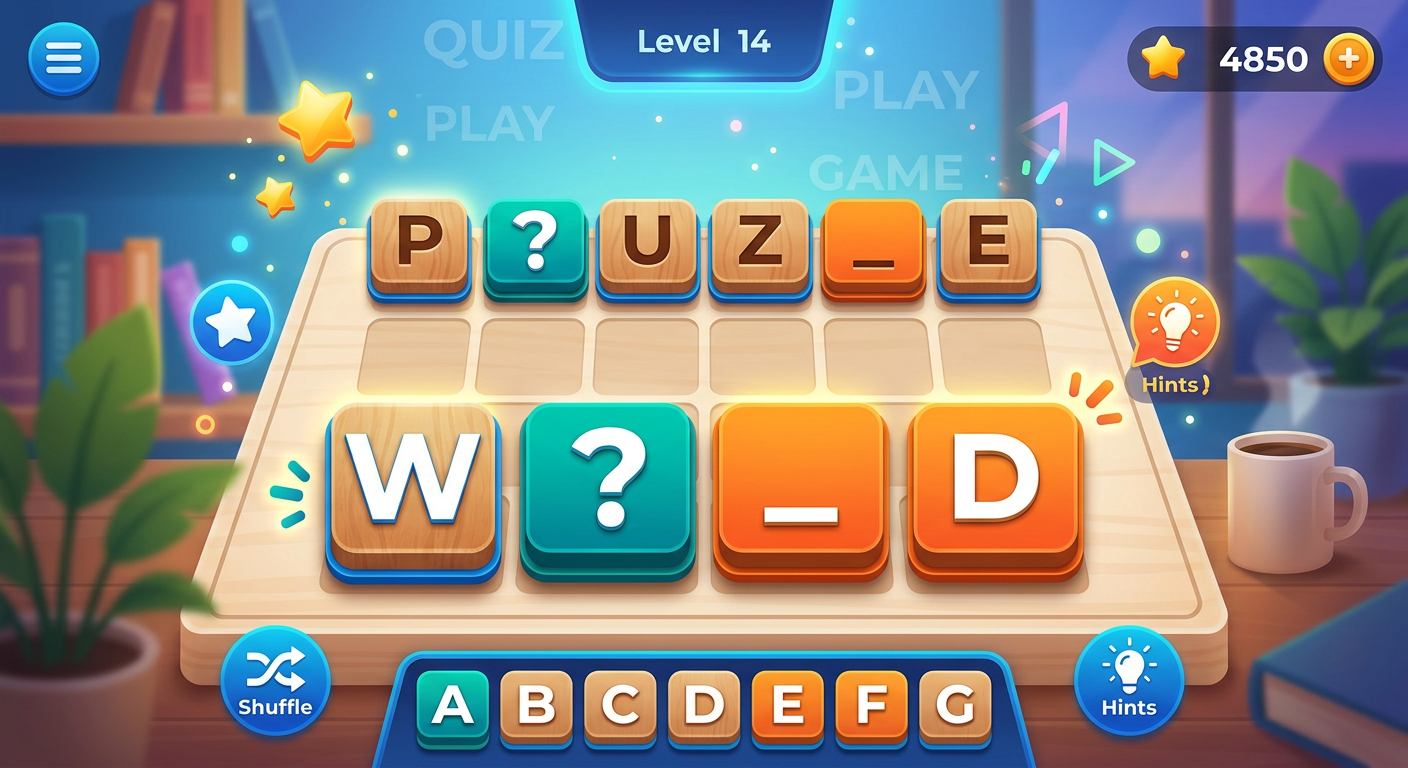
Wildcards are one of the most powerful features of a word unscrambler. They let you represent any unknown or flexible letter, dramatically expanding the range of words you can find. Whether you have a blank tile in a word game, a missing letter in a crossword, or simply want to explore more possibilities, wildcards solve the problem. In this guide, we explain how wildcards work, show practical examples, and share tips for getting the most out of them. You can try these techniques directly in our wildcard unscrambler.
What Are Wildcards?
A wildcard is a special character that represents any letter. In our word unscrambler, two characters work as wildcards:
- Question mark (?): Represents any single letter from A to Z.
- Underscore (_): Also represents any single letter. It works identically to ?.
When you enter a wildcard, the tool treats that position as flexible. It tries every letter of the alphabet in that spot and includes all valid words in the results. This is exactly how a blank tile works in tile-based word games — it can be any letter you need.
When to Use Wildcards
Wildcards are useful in several common scenarios:
1. Blank tiles in word games
If you draw a blank tile in Scrabble, Words With Friends, or a similar game, it can represent any letter. Enter it as ? in the unscrambler to see all possible words. For example, if your rack is C, A, R, E, ?, the tool finds every word from CARE plus any fifth letter.
2. Missing letters in crosswords
Crossword clues often give you some letters and leave others blank. If you know the word is S_T_R, enter S?T?R to find all matching words like STARTER (7 letters, too long), but also STAIR (5 letters: S, T, A, I, R — that matches S?T?R? No, STAIR is S, T, A, I, R — does not match S_T_R). Better examples: S?T?R could match SUTRA (S, U, T, R, A — no, that is 5 letters: S, U, T, R, A — pattern is S_UTRA... does not match S?T?R). Let us use a cleaner example: C?T matches CAT, COT, CUT, and many others. This is the simplest and most common crossword use case.
3. Exploring more word possibilities
Even without blank tiles, adding a wildcard to your search reveals words you might not have considered. If your letters are RATE and you want to see what 5-letter words are possible with any additional letter, enter RATE? to expand your search.
4. Guessing games with partial information
In 5-letter guessing games, you often know some letters and their positions but not others. If you know the word is _R_N_, you can enter ?R?N? with a length filter of 5 to find all matching words like BRINE, CRANE, BRAIN (no, that is B,R,A,I,N — matches ?R?N? if the pattern is _R_N_... BRAIN is B,R,A,I,N which is ?R??N, not ?R?N?). Better example: ?R?N? matches words like TRAIN (T,R,A,I,N — no, that is ?R??N). The correct matches for ?R?N? (5 letters, 2nd letter R, 4th letter N) include words like GREEN (no, G,R,E,E,N — yes, 2nd is R, 4th is E not N). Let us reconsider: the pattern ?R?N? means positions 2=R, 4=N. Matching words: URGENT (too long), BRAIN (B,R,A,I,N — position 4 is I, not N). Actual matches: BROWN (B,R,O,W,N — position 4 is W, not N). Correct matches include: URINE (U,R,I,N,E — position 2 is R, position 4 is N — yes!) and GROIN (G,R,O,I,N — position 4 is I, not N). So URINE is a match for ?R?N?. Using the tool with filters is far more reliable than doing this mentally.
Practical Examples
Example 1: RATE? — Finding 5-letter words
Enter RATE? into the unscrambler. The ? represents any letter. The tool finds all 4-letter words from RATE (RATE, TEAR, TARE, EAT, ATE, ART, EAR, RAT, TEA) plus all 5-letter words that can be formed from R, A, T, E, and any additional letter. This includes words like WATER (if the ? is W), ALERT (if ? is L), ALTER (if ? is L), TAVER (not valid), and many others. The tool shows every possibility instantly.
Example 2: B??D — Crossword pattern
If you have a 4-letter crossword answer with B as the first letter and D as the last, enter B??D. The tool finds all 4-letter words matching this pattern: BAND, BARD, BEAD, BEND, BILD (not valid), BIRD, BOLD, BOND, BOOD (not valid), BRAD, BRED, BUILD (5 letters, too long). Valid matches include BAND, BARD, BEAD, BEND, BIRD, BOLD, BOND, BRAD, and BRED — nine possibilities from just two known letters.
Example 3: S?A?E? — A longer pattern
This 6-character input has three wildcards. The tool tries every letter in each wildcard position and returns all valid 6-letter words matching S_A_E_. This might include SEANCE (S,E,A,N,C,E — does not match S?A?E? since position 2 is E not ?, position 5 is C... pattern is S,?,A,?,E,? so position 2 is any, 4 is any, 6 is any). Matches include SLATES (6 letters: S,L,A,T,E,S — position 2=L, 4=T, 6=S — matches!), STATES (S,T,A,T,E,S — matches!), SPATES (S,P,A,T,E,S — matches!), and SNARES (S,N,A,R,E,S — position 5 is E, position 4 is R — matches S?A?E? since position 5 must be E: yes, SNARES is S,N,A,R,E,S — position 5 is E, so it matches). The tool handles this complex search instantly.
Tips for Effective Wildcard Use
Combine wildcards with length filters
Wildcards expand results, so narrowing them with a length filter is essential. If you enter RATE? without a filter, you get all words from 2 to 5 letters. Set the length filter to 5 to see only the 5-letter results, which are the ones the wildcard specifically enables.
Use starts-with and ends-with filters
If you know the first or last letter, combine it with wildcards for the unknown middle. For example, if you know a word starts with S and contains a wildcard, enter S?? with a "starts with S" filter and a length filter. This is faster than entering S?? and sorting through all results.
Limit the number of wildcards
Each wildcard multiplies the search space by 26. One wildcard is manageable. Two wildcards produce up to 676 combinations. Three wildcards produce over 17,000. While the tool handles this efficiently, the result lists become very long. Use as few wildcards as possible and rely on filters to narrow the output.
Remember scoring implications
In tile-based games, blank tiles typically score zero points. If you use a wildcard in your search and the resulting word depends on the blank tile, the score shown by the tool may not reflect the zero value of the blank. Always recalculate scores manually when blanks are involved, or check your game's specific scoring rules.
Wildcards in Different Word Lengths
Wildcards work across all word lengths. For shorter words, they are particularly powerful because there are fewer total possibilities. A single wildcard in a 5-letter word search can reveal a manageable number of new options. In 7-letter word searches, a wildcard can be the difference between finding a bingo and missing it entirely, especially when you have a blank tile on your rack.
For the full wildcard experience, visit our dedicated wildcard unscrambler page, which is optimized for wildcard searches. For more general strategies, read our tips and tricks guide.
Common Wildcard Mistakes
- Using too many wildcards. Three or more wildcards without filters creates an overwhelming list. Start with one or two and add filters.
- Forgetting to set a length filter. Without a length filter, wildcard results include all word lengths, making it hard to find what you need.
- Ignoring scoring. Remember that blank tiles score zero in most games. A word found with a wildcard might score less than a shorter word using only real tiles.
- Not trying both ? and _. Some keyboards or input methods make one easier to type than the other. Both work identically, so use whichever is convenient.
Frequently Asked Questions
What characters can I use as wildcards?
Our word unscrambler supports the question mark (?) and the underscore (_) as wildcard characters. Both represent any single letter. You can use them interchangeably — enter whichever is more convenient on your keyboard.
How many wildcards can I use at once?
You can use multiple wildcards in a single search. However, each wildcard dramatically increases the number of possible results, so using more than two or three at a time can produce a very large list. For best results, use wildcards sparingly and combine them with filters.
Do wildcards work with all filters?
Yes. Wildcards work alongside length, starts with, ends with, and contains filters. Combining wildcards with filters is the most effective way to narrow results, especially when you have partial information from a crossword or guessing game.
Should I always use my blank tiles as wildcards in a search?
If you have a blank tile in a word game, using a wildcard in your search helps you see all possible words. However, remember that blank tiles usually score zero points in tile-based games, so factor that into your scoring calculations when choosing which word to play.