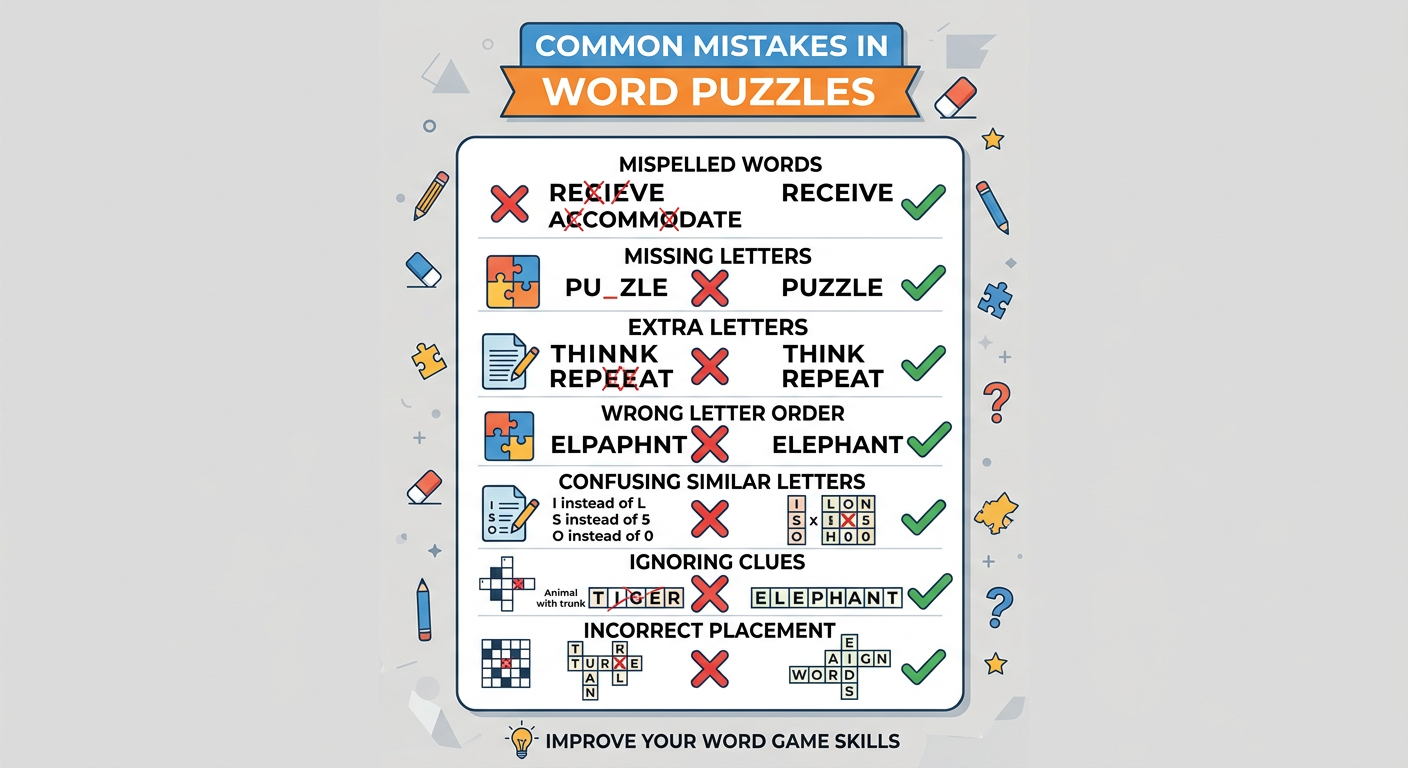
Even experienced word-game players and puzzle solvers fall into habits that cost them words and points. The good news is that nearly every common unscrambling mistake has a simple fix. This guide walks through the seven most frequent errors people make when using a word unscrambler or unscrambling by hand, and shows you exactly how to avoid each one. Whether you play Scrabble, tackle daily Wordle, or solve newspaper jumbles, correcting these habits will immediately improve your results.
Mistake 1: Only Looking for One Word
The single most common mistake is stopping after finding a single word. Given the letters R, A, T, E, many people spot RATE and move on. But those same letters also spell TEAR, TARE, EAT, ATE, ART, EAR, RAT, and TEA. In a word game, each of those is a potential play. In a vocabulary exercise, each is a word to learn.
How to avoid it: Train yourself to ask "what else?" after every find. Before moving to a new letter set, scan for shorter words, plural forms, and alternative arrangements. When using the tool, do not just grab the first result — scroll through the full list. You will often find a higher-scoring or more useful word further down.
Mistake 2: Ignoring Short Words
There is a natural bias toward long words because they feel more impressive. But in tile-based games, short words are often the smartest plays. A two-letter word like QI (using the Q) can score more than a five-letter word of common letters, especially when it lands on a bonus square. In crosswords and jumble puzzles, the answer is frequently a short word that solvers overlook while hunting for something longer.
How to avoid it: Always check for two- and three-letter words first, not last. They are fast to spot and often the highest-value plays. Memorize the valid two-letter words for your game's dictionary — there are roughly one hundred in standard Scrabble, and knowing them transforms your play. Our tool lists short words alongside long ones, so make a habit of scanning the bottom of the results, not just the top.
Mistake 3: Forgetting Plurals and Inflected Forms
If you find the word CAT, you should immediately check for CATS. Find RUN, check for RUNS, RAN, and RUNNING. Many players find a base word and forget that adding an S, D, or ING creates additional valid words from the same letters plus one more. This is especially costly in games where an S on the end of a word can also hook onto another word on the board for double points.
How to avoid it: Build a reflex: every time you find a noun, test whether you have an S. Every time you find a verb, test whether you have the letters for S, ED, or ING. The tool shows these automatically, so the real work is training yourself to look for them. A simple mnemonic helps: "Find the root, then add the endings."
Mistake 4: Missing Prefixes and Suffixes
Prefixes and suffixes are the easiest way to turn a four-letter word into a seven-letter word, yet many unscramblers forget to look for them. If you find PLAY and you also have R and E, you have REPLAY. If you find DO and have UN, you have UNDO. These affixes multiply the number of words available from any letter set.
How to avoid it: Keep a mental (or physical) list of common prefixes — RE, UN, IN, DE, DIS, MIS, PRE, OUT, OVER, UNDER — and suffixes — ING, ED, ER, EST, LY, TION, NESS, MENT, ABLE, FUL, OUS, LESS. Before finalizing your word list, scan your letters for these blocks. The tool finds them automatically, but training your eye to spot them makes you faster when solving by hand and helps you recognize the best results faster when using the tool.
Mistake 5: Not Using Filters
Many people type their letters into the unscrambler and then struggle through a long, unsorted list of results. This is like searching the internet without search terms. Filters exist to focus the results on exactly what you need, and ignoring them is one of the biggest sources of missed answers and wasted time.
How to avoid it: Use filters deliberately for each situation:
- Length filter: Set it to the exact number of squares in a crossword answer, or to 5 for Wordle-style games. Our 7-letter word unscrambler is a length-filtered tool that is ideal for Scrabble bingos.
- Starts with / Ends with: Use these for crossword clues where you know the first or last letter.
- Contains: Use this when you must include a specific letter, such as a Q or a bonus-square letter.
- Wildcards: Use ? or _ for blank tiles or unknown letters. Our wildcard unscrambler handles this elegantly.
Combining two or three filters narrows results to a manageable, highly relevant list. The difference between an unfiltered search and a well-filtered one is often hundreds of irrelevant words versus a dozen perfect ones.
Mistake 6: Overlooking Rare and High-Value Letters
Letters like Q, X, Z, and J are worth the most points in tile-based games, yet many players treat them as a burden and hide them at the end of words or avoid using them entirely. Others use them but miss the highest-scoring placement because they did not sort results by score. The result is leaving significant points on the board every game.
How to avoid it: When your letters include a rare letter, make it the centerpiece of your search, not an afterthought. Use the "contains" filter to force the tool to show only words that include that letter. Then sort by score so the highest-value plays rise to the top. Learn the short words that use these letters — QI, XU, ZA, JO, AX, OX, XI — because they are easy to place and disproportionately valuable.
Mistake 7: Not Sorting by Score
Even players who find all the words often choose a suboptimal one because they default to the longest word rather than the highest-scoring one. A six-letter word of common letters like RATION often scores fewer points than a four-letter word with a K or X placed on a triple-letter square. Without sorting by score, you cannot see which option actually wins.
How to avoid it: Always check the score-sorted view before committing to a play in a tile-based game. Compare the top two or three options against the current board position — bonus squares and hooks onto existing words can change the calculus. For anagram puzzles and vocabulary work, sorting by length or alphabetically is fine, but for scoring games, score sort is essential.
Putting It All Together: A Corrected Workflow
Avoiding all seven mistakes comes down to following a consistent workflow every time you unscramble:
- Enter your letters and apply filters — set length, starts/ends/contains, and wildcards based on your situation.
- Sort by score if you are playing a tile game, or by length if you are solving a puzzle.
- Scan the full list, not just the top — short words and plural forms often sit further down.
- Check for affixes — does your best word have a prefix or suffix variant that adds another option?
- Account for rare letters — make sure you have considered plays that use your Q, X, Z, or J.
- Choose based on the situation — highest score for games, exact length for crosswords, full anagram for jumbles.
This workflow takes only a few seconds longer than grabbing the first result, and it consistently produces better outcomes.
Practice Makes Permanent
Recognizing these mistakes is the first step; correcting them requires practice. After each game or puzzle, take a moment to enter your letters into the unscrambler and compare what you found against the full result list. Every word you missed is a lesson about which mistake you made. Over time, the corrected habits become automatic, and your word count and scores will climb steadily.
For foundational techniques to pair with this guide, read our step-by-step unscrambling guide and our tips and tricks article. If you want to understand when to use different tools, our word unscrambler vs anagram solver comparison clarifies the distinction.
Frequently Asked Questions
What is the most common mistake when unscrambling words?
The most common mistake is stopping after finding a single word. Most letter sets contain many valid words of different lengths, and settling for the first answer means leaving points and vocabulary on the table. Always scan for shorter words, plurals, and words with prefixes or suffixes before moving on.
Why am I missing words that the unscrambler finds?
You are likely overlooking short words, plurals, or words formed with common prefixes and suffixes. The human brain tends to fixate on the full-length anagram and skips over two- and three-letter possibilities. Practicing with a systematic approach — vowels first, then digraphs, then affixes — closes this gap quickly.
Should I always sort unscrambler results by length?
Not always. Sorting by length is useful for vocabulary building and anagram puzzles, but sorting by score is better for tile-based games like Scrabble where point value matters more than word length. Try both sort orders on the same letter set to see different possibilities you might otherwise miss.
How do filters improve my unscrambling results?
Filters narrow results to exactly what you need. A length filter focuses on words of a specific size, a "starts with" filter helps with crosswords, and a "contains" filter targets specific letters like Q or Z. Without filters, you face a long unsorted list that is easy to skim past valuable answers.